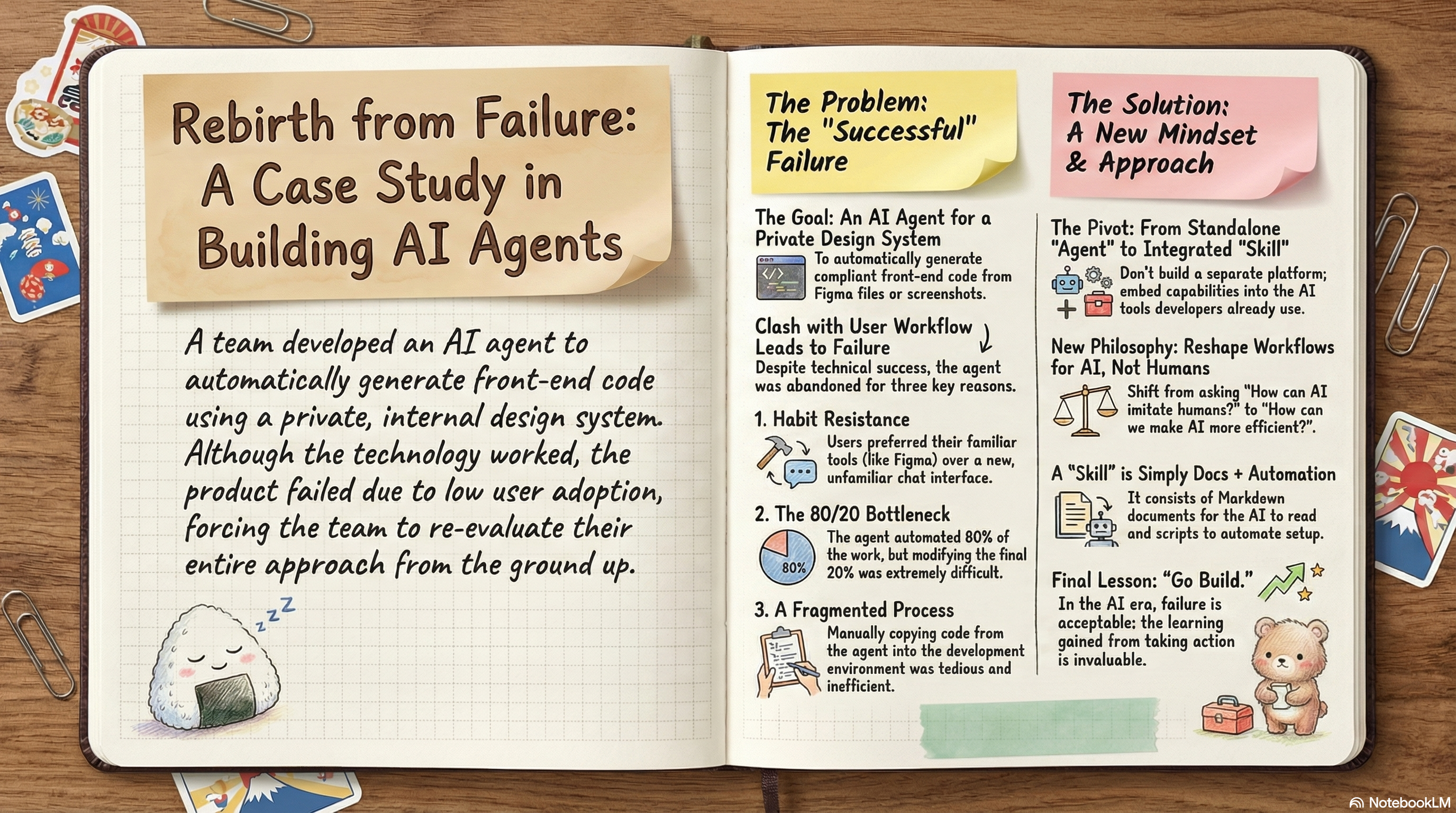
Final Lesson:“Go Build."
It consists of Markdewn documents for the AI to read and scripts to automate setup.
A "Skill" is Simply Docs + Automation
Shift from asking "How can AI imitate humans?" to "How can we make AI more efficient?".
New Philosophy: Reshape Workflows for AI, Not Humans
Don't build a separate platform; embed capabilities into the AI tools developers already use.
The Pivot: From Standalone "Agent"toIntegrated"Skill"
In the AI era, failure is acceptable: the learning gained from taking action is invaluable.
+
The Solution: A New Mindset & Approach
Manually copying code from the agent into the development environment was tedious and inefficient.
3.A Fragmented Process
The agent automated 80% of the work, but modifying the final 20% was extremely difficult.
2.The 80/20 Bottleneck
Users preferred their familiar tools (like Figma)over a new, unfamiliar chat interface.
1.Habit Resistance
Clash with User Workflow LeadstoFailure Despite technical success, the agent was abandoned for three key reasons.
To automatically generate compliant front-end code from Figma files or screenshots.
The Goal: An AI Agent for a Private Design System
The Problem: The "Successful" Failure
entire approach from the ground up.
forcing the team to re-evaluate their
product failed due to low user adoption,
Although the technology worked, the
using a private, internal design system.
automatically generate front-end code
A team developed an AI agent to
Building AI Agents
A Case Study in
Rebirth from Failure:
NotebookLM